


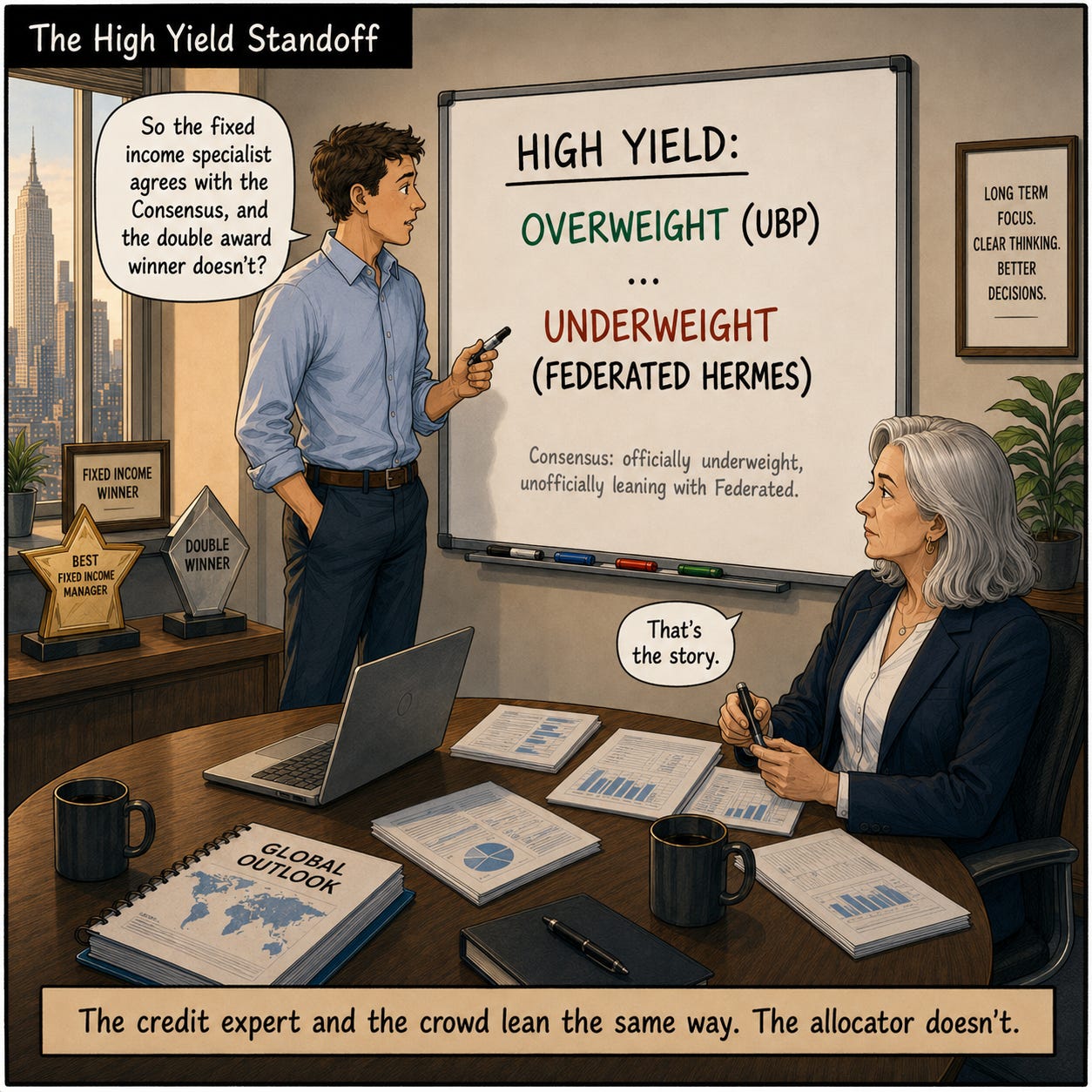
Three of the thirteen finalists in the 2026 Asset Allocation Awards published their July outlooks this week, during an unusually quiet stretch for markets. Federated Hermes, T. Rowe Price, and UBP share one conviction: earnings growth, not valuation, is driving equities. But the agreement breaks down the moment credit comes up.
UBP, double winner of the Asset Allocation Awards (Asset Allocation Award and Asset Allocation Award Overall), names the shift toward Europe and away from defence and China as one of five key changes this month: “We have exited defence and China, tilting instead towards Europe and emerging markets.” The formal regional rating for Europe, China, and EM stays at baseline, though, no dot, so no official rating change. What is table-confirmed: credit conviction (high yield/AT1, 3/5 to 4/5) and gold (5/5 to 4/5).
T. Rowe Price, nominee for the Asset Allocation Awards (Equities, Overall), is underweight European equities ex-UK despite fiscal support and falling energy prices, this one does sit explicitly in the official rating table. In the US, the firm favours Growth over Value: “this is not a call to chase Growth indiscriminately.” Duration stays cautious under new, less forthcoming Fed Chair Warsh.
T. Rowe Price, Global Asset Allocation: The View From Europe, July 2026↗
Federated Hermes, winner of the Fixed Income Award, is the most risk-seeking of the three at 6% overweight equities: earnings outweigh geopolitical noise, as “overcoming ‘walls of worry’ often leads to healthier and higher equity returns.” Within its own core expertise, fixed income, the firm stays cautious: high yield sits underweight on tight spreads and slow Fed cuts.
Federated Hermes, Where We Stand, July 2026↗
What This Means for the Consensus
The panel splits on high yield: UBP raises conviction to 4/5, while Federated Hermes, the Fixed Income Award winner, stays underweight. That tracks the Consensus: officially Neutral, but clearly skewed toward underweight (35.7% versus 17.9% overweight). Specialist and Consensus point the same way.
Editor’s Note
House Views tracks how winners and finalists of the Asset Allocation Awards, organised by Alpha Research, think and position. Not to predict markets, but to understand how investment views evolve before the consensus catches up.
Indeed.
Consensus often hides the most interesting signal.
When investors broadly agree on equities but disagree sharply on credit, it's usually worth asking which market is pricing the macro cycle more accurately.