



Government bonds are supposed to be the insurance policy against falling equity markets. They no longer offer that. And the category ranked least attractive of the five in this month’s consensus is the best-performing fixed income asset class of the year.
Within fixed income, High Yield ranks last this month. Five categories, one ranking: Emerging Markets Debt overweight, Inflation Linked Bonds and Corporate Bonds neutral, Government Bonds neutral with a slight improvement, and High Yield at the bottom, underweight, unchanged from last month. Spreads confirm the picture. On August 31, the U.S. HY spread stood at 2.65%, the European spread at 2.63%. Two regions, nearly identical levels, both close to the cycle’s low.
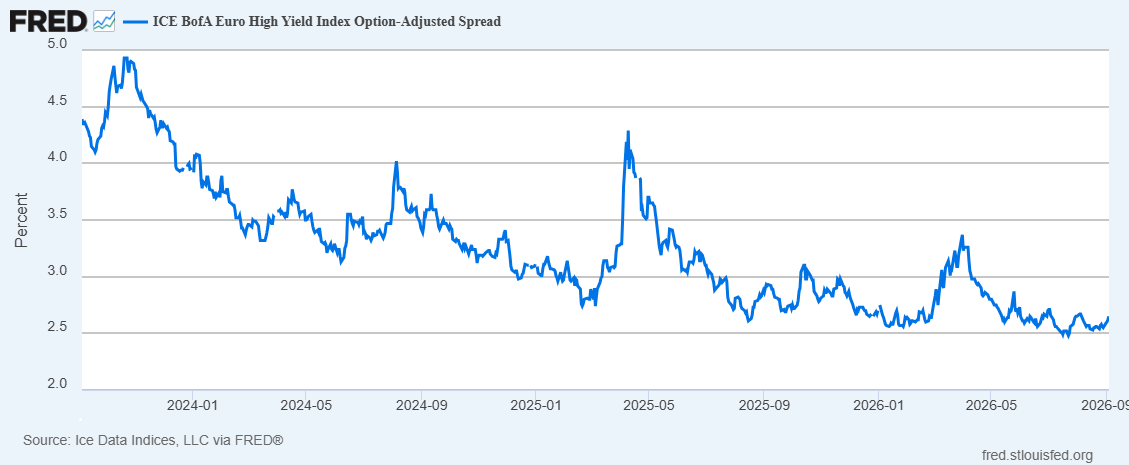
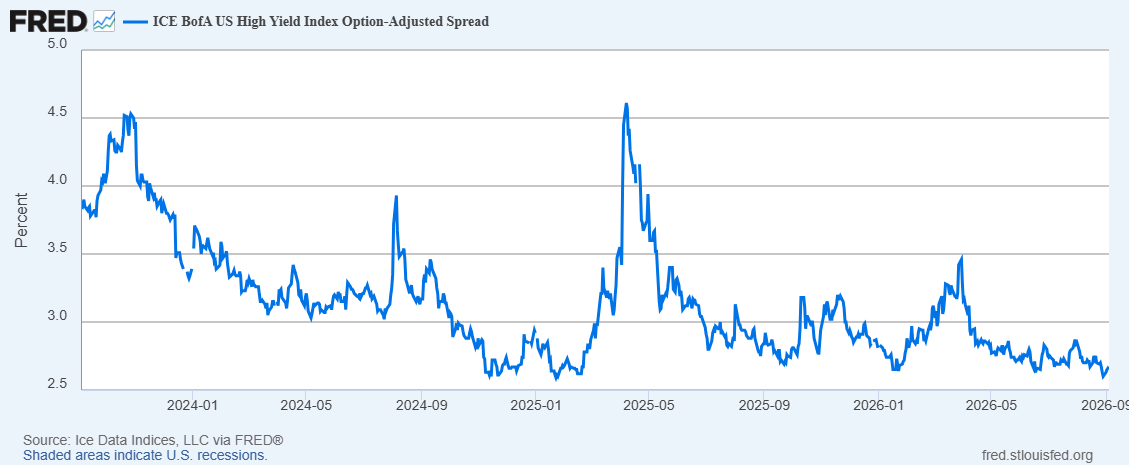
Two layers, two choices
The allocation decision around High Yield plays out on two levels. At the top, whether the risk budget goes to equities or to credit: HY has traditionally correlated closely with equities, so choosing credit often means buying a diluted version of the same risk. Below that, within fixed income itself, which slice of that risk you want to carry. Rate view and duration on one side, credit risk on the other.
Buying government bonds now means buying duration without much compensation. High Yield asks for the opposite trade: credit risk, at a price that’s historically low.
That second choice is exactly what makes this month’s ranking legible. EMD is favored because it offers a return that’s missing elsewhere, Inflation Linked Bonds remain insurance against a scenario nobody rules out. High Yield bears the compensation problem hardest.
What the equity market is saying
The cross-asset signal comes from the equity market. As long as equities keep structurally climbing, demand for corporate risk stays high, and that compresses the compensation investors demand for carrying the same risk through credit. Steve Chiavarone, Deputy CIO Equities at Federated Hermes, winner of the Fixed Income Award at the Asset Allocation Awards, made exactly this case in this magazine in July: when spread on the riskier parts of fixed income isn’t sufficient, the risk budget moves into equities. What was a tactical call at Federated Hermes now shows up broadly in the High Yield ranking. Equities send, credit receives, and the message is simple: a cheaper alternative exists for this level of risk.
Government bonds play into this too. Northern Trust points out that bonds are losing their diversification benefit, they now move more closely with equities than they did in the decade after the financial crisis. Buying duration as protection therefore buys less protection than before. That makes the choice within fixed income harder than it was a year ago.
The case for and against
Bull case: 7 of the 58 managers with a view on High Yield are overweight, 12.1%. The argument is largely technical. Low duration and an attractive running yield, as ING Investment Office and T. Rowe Price both stress. MFS points to all-in yields above 7% in the U.S. Standard Chartered calls U.S. High Yield tactically bullish, UBP maintains selective exposure for extra carry.
In Europe, the picture has cautiously improved: Schroders saw technical conditions ease after a quiet summer for issuance, Allianz Global Investors and Wells Fargo both call the category resilient. A quality argument often missing from the debate: the share of BB-rated bonds in the global HY index rose from 39% in 2007 to 62% now, CCC fell from 15% to 7%. Today’s asset class carries structurally less risk than it did fifteen years ago.
Bear case: 21 of the 58, 36.2%, are underweight. Amova AM, Wellington, TD Asset Management and Fidelity all say spreads are too tight for further compression. BlackRock took a new step this quarter: a structural underweight in High Yield, favoring equities and private infrastructure equity instead.
Regionally, the picture is sharper still. Candriam is negative on U.S. High Yield, UniCredit runs an explicit underweight. DWS downgraded European High Yield over geopolitical risk tied to the Gulf conflict, HSBC holds a similar negative bias. Voya and MFS both say the extra compensation for the extra risk is simply too small to be worth it.
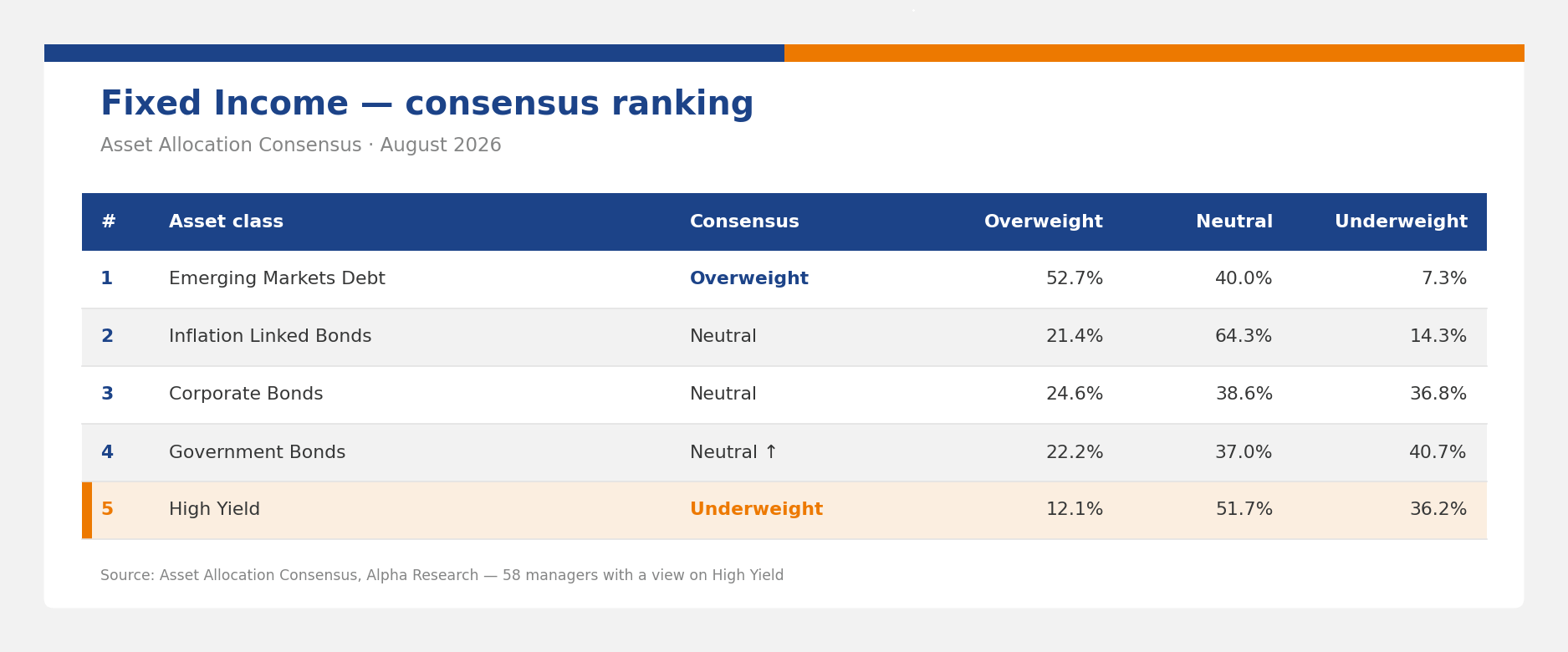
Yet the consensus sits uneasily next to the numbers. High Yield ranks last, but has been the best-performing fixed income category of the five this year: +0.77% in August, +1.88% year to date, the highest reading on both counts. Government bonds, the category meant to provide protection, lost the most: -1.82% YTD. Consensus looks forward to a compensation problem, performance looks back on a year in which that problem hasn’t yet shown up.
The hinge
Northern Trust is the most striking dissenting voice in this story: eleven-time laureate at the Asset Allocation Awards over eleven years, across the Asset Allocation, Regional Allocation and Overall categories. The panel data places the manager explicitly overweight High Yield as of August 2, while its broader bond book sits underweight at the same moment: Bonds overall, Corporate Bonds and Inflation Linked Bonds all at -1. That isn’t an inconsistency. It’s the exact split from this article’s opening, in practice: Northern Trust wants no duration, but does want credit risk.
Historically, the current positioning isn’t unusual. In 30 of the past 166 months, 18% of the time, High Yield has already been the least attractive fixed income category. CIOs have occasionally been more negative in number, but not structurally. So the question isn’t whether this is unprecedented. It’s what would need to change. The hinge is the fourth-quarter issuance calendar: if it stays slow, the technical support holds. If the refinancing wave arrives sooner than expected, compensation shifts faster than the ranking does.
The insurance policy that no longer pays out returns on its own once its price changes. Right now the reverse holds: government bonds offer less protection than before, and credit has to earn its own protection, at a compensation that simply isn’t there at this level. That High Yield happened to deliver the best return this year changes nothing: spreads price what’s still to come, not what already happened. Spreads will speak again once that changes. Until then, High Yield is mostly expensive: the same risk is cheaper to find elsewhere.
New to this? Credit spreads are the price investors demand for carrying credit risk on top of safe government bonds, and that price is now historically low for High Yield. For your portfolio, that means the same level of risk is currently cheaper to find in equities than in high-yield corporate bonds.