



Sixty-six recommendation changes this month, against 54 in July, and yet the consensus barely moves. 51.5% of the changes were positive, 48.5% negative, almost identical to last month’s split.
Our database counted 69 reports current enough to qualify this cycle, 53 of them brand new. Most of the movement isn't visible in the headline recommendations. It happens beneath the surface. Regional allocation stands out the most: from 14 changes in July to 25 this month, and that shift, as it turns out, runs in the same direction as the rest of this cycle.
That balance isn’t a product of calm. ince late February, the world's most important oil shipping route, the Strait of Hormuz, has been largely shut following the US-Israeli air war with Iran.. In early August both countries signed a memorandum to reopen the passage, after which Brent fell nearly 5% in a single day, having gained almost 24% in July.
US inflation eased to 3.5% in June, while the eurozone climbed to 2.9% in July, both still much closer to 3% than to central banks' 2% inflation target. Yet the consensus isn’t heading for shelter: equities and commodities keep their preference, while cash keeps losing ground. Risk-on remains the dominant positioning, even with the gateway for a fifth of the world’s oil trade still hanging ajar.
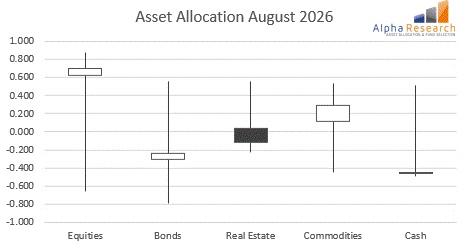
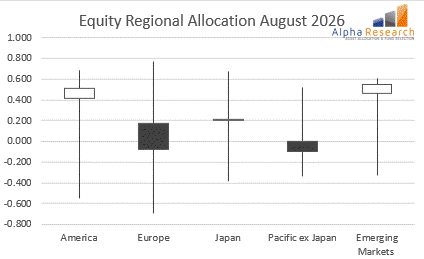
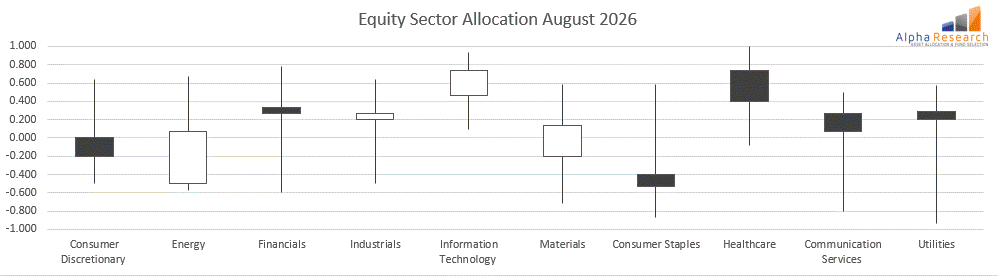
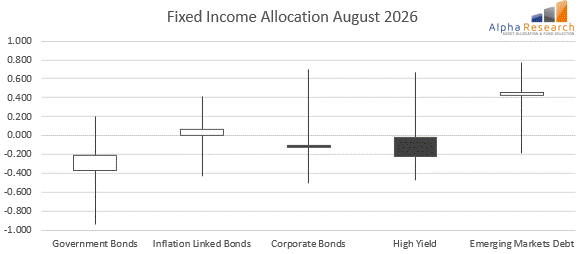
The four charts below show exactly where that consensus stands this month, each measured against its full history since 2012. White candle: the score rose in 2026. Black candle: it fell. The wick marks the highest and lowest score ever recorded for that category since 2012.
Asset Allocation
None of the headline categories change their consensus recommendation. Underneath, plenty shifts, especially in bonds and cash.
Bonds climb from fifth place to fourth. Within the category, recommendations move from Underweight and Neutral toward Overweight, pushing the consensus score materially up from -0.417 to -0.237. Bonds remain underweight, but the tone turns noticeably less negative.
Cash becomes the least attractive asset class, dropping to the 98.8th percentile of all observations since 2012, only 1 to 2% of the past fourteen years scored more negative.
Commodities remain the second-favorite asset class after equities. Overweight and Neutral both decline, Underweight increases, but the consensus stays positive. Of the 165 months measured, only about 30 scored higher, commodities remain historically very strongly valued.
Regional Allocation
Only one consensus recommendation changes here: Pacific ex Japan drops from Overweight to Neutral. The underlying movements are more interesting than that single change.
Emerging Markets remain the favorite equity region and keep their Overweight rating. Both Overweight and Underweight decline, while Neutral increases, strategists are drifting slightly toward the middle without abandoning their preference.
US equities move the opposite way: Underweight and Neutral shift toward Overweight, pushing the consensus score higher still. The gap with Emerging Markets narrows, but the ranking holds: Emerging Markets first, the United States second.
Both regions remain in the historical top tier: of roughly 165 months measured, only about 10 to 11 scored higher each time. Neither EM nor the US has often been priced this convincingly. Here too, caution isn’t winning out, risk appetite is, in line with the broader picture this month.
Fixed Income
Emerging Market Debt remains the favorite fixed income category. As with EM equities, both Overweight and Underweight decline in favor of Neutral. The recommendation doesn’t change, but conviction softens slightly. Historically, EM Debt remains by far the most strongly valued category within fixed income.
Government Bonds climb from fifth to fourth place: many Underweight recommendations move to Neutral, and part of the Overweight positions shift the same way. Government Bonds remain underweight, but are no longer the least attractive fixed income category.
That distinction now belongs to High Yield, which has slipped into the historically least attractive fixed income categories.
Sectors
Most of this cycle’s consensus changes happen here: three recommendations flip at once.
Financials makes the biggest jump. Almost every shift runs from Underweight to Overweight, giving the sector not only an Overweight rating but also a climb from sixth to third place in the ranking.
Utilities move the opposite way: nearly every shift runs from Overweight to Neutral, with a small portion heading to Underweight. Notably, the sector still ranks among the historically best-valued, this month’s downgrade stands in sharp contrast with the long-term picture.
Consumer Discretionary follows the same path from Overweight to Neutral, sliding close to the bottom of its own historical range.
Consumer Staples becomes the least attractive sector of the ten: Overweight and Neutral both decline, Underweight increases, and the sector drops from ninth to tenth place.
Not every move points the same way. While bonds and Financials gain conviction, Underweight calls also grow for commodities, and High Yield keeps losing ground. Part of the reports still holds a more defensive reading, even if that view is in the minority this time.
The clearest pivot to watch for the next cycle: whether Financials’ climb to Overweight holds, or whether the fragile shift toward Underweight in Utilities continues. On the macro side, the Hormuz memorandum is still fresh and fragile, a slide back into an actual closure would be the first real test for this month’s risk-on consensus.
Sixty-six recommendation changes would normally suggest uncertainty. This month they suggest the opposite. Beneath the individual revisions lies a remarkably stable message: professional investors continue to prefer taking risk over hiding in cash. The headlines changed. The conviction didn't.
New to this?
Despite a largely closed Strait of Hormuz, wild swings in the oil price, and inflation running closer to 3% than to 2%, professional investors are still choosing equities and commodities over cash this month, what’s known as “risk-on.” For private investors, that means the average professional still prefers owning risk assets rather than sitting on cash, despite a macro backdrop that would seem to justify the opposite.