



In the space of a single month, the topic of inflation has evolved from a belief to a given. In September, this topic was addressed in 72 per cent of reports containing new analyses. In October, the figure was almost 98 per cent. Concerns about inflation have risen from sixth place to joint second place in the Asset Allocation Consensus, based on 67 recent reports.
The signal for October: positive for growth, negative for bonds.
For each theme, we measure how many reports cover it (breadth) and what proportion of these link the theme to a specific investment decision (action ratio). The score is then calculated as the breadth multiplied by the action ratio. Macro themes are assessed solely on the basis of reports from September; this month, 44 out of 67, compared with 39 in September.
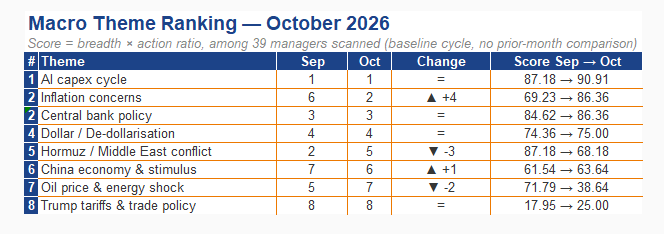
Little has changed at the top. The AI investment cycle has risen to 90.91, and this is highlighted in virtually every report. The debate has now shifted to scale, funding and valuation. Several reports estimate that hyperscalers’ spending this year will run into the hundreds of billions, with projections for 2027 of nearly 1 trillion dollars.
This money is flowing not only into the technology sector, but also into semiconductors, electricity grids, utility companies, copper and the Asian chip supply chain. It is striking that an ever-increasing proportion is being financed through debt, which means that even loans with an ‘investment grade’ rating are being drawn into the AI narrative.
As far as inflation is concerned, the market is almost fully priced in, and the action ratio has fallen from around 96 per cent to 88 per cent. Nevertheless, there are now 38 reports, compared with 27 in September. What was initially the firm conviction of a small group of asset managers is now an assumption shared by almost everyone. Persistent inflation does, however, limit the scope for interest rate cuts, meaning the consensus remains cautious regarding government bonds with a long duration.
The role of bonds in diversifying a portfolio is also less self-evident, as, logically, an inflationary shock affects both shares and bonds at the same time.
The conflict in the Middle East is developing in the opposite direction. Almost 89 per cent of the updated reports still focus on Hormuz, but the number responding to this has fallen from 34 to 30. The theme has slipped from joint first place to fifth this month.
The sharpest decline in the table is seen in the oil price: from 71.79 to 38.64. The conflict has shifted from being a direct trigger for portfolio adjustments to a background risk.
The other camp: not every report mentioning inflation actually leads to action. Five of the 43 reports highlight the risk but do not alter their bond recommendations. Moreover, the geopolitical risk itself remains unchanged; oil supply and the escalation in the Middle East continue to have a direct impact on inflation and growth.
Something to watch: the price of oil. A fresh escalation around the Strait of Hormuz would immediately bring the risk—currently lurking in the background—back to the forefront. This would instantly reignite concerns about inflation, which are already ranking second in importance. Inflation has clearly shifted from mere conversation to investment portfolios. The situation surrounding Hormuz is once again moving in the opposite direction. Talk is cheap, but in the bond market, discussions about inflation rarely go without consequences for long.
New to this? Virtually every serious investor is talking about inflation this month, making bonds a less obvious safe haven. If you are saving or investing for the long term, this affects the interest you receive and the risk you run.