


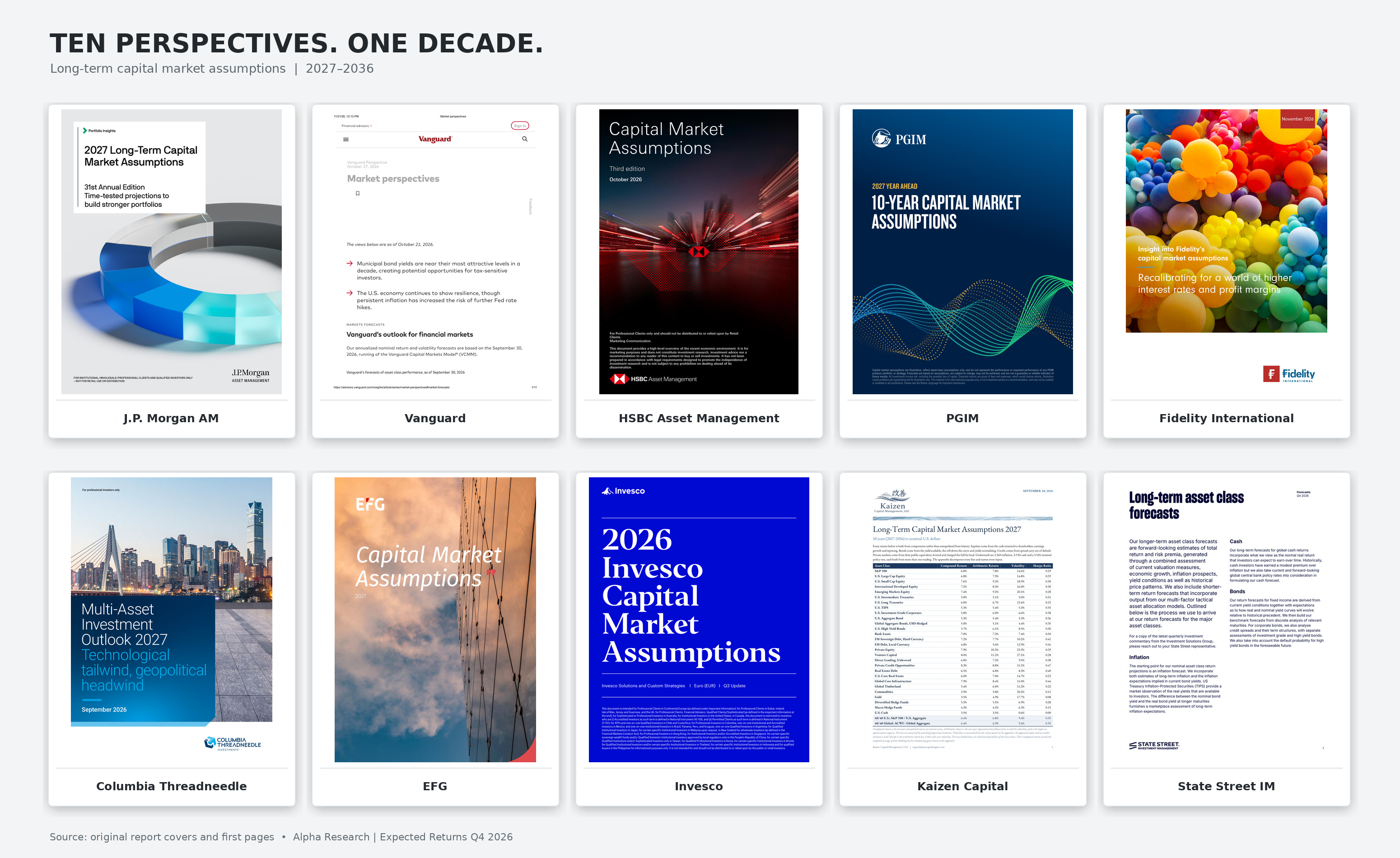
Everyone is talking about AI, and mostly about whether it is a bubble. The ten asset managers whose long-term expectations I have been reading over the past few days are no exception.
J.P. Morgan AM sees an investment wave of 15 trillion dollars and expects the best growth outlook in fifteen years. PGIM looks at the same development but sees no reason yet to raise its productivity expectations. Columbia Threadneedle warns of overcapacity, and Fidelity is concerned about how all those new data centres are being financed.
Who is right?
We don’t know yet, and we don’t need to. Behind these Capital Market Assumptions reports are economists, strategists and portfolio managers. Each of them uses their own models and makes their own assumptions. So it is only logical that different expectations come out of them.
It is exactly those differences that I find interesting. A house view is, after all, a conviction that an asset manager chooses to stand behind. If everyone ends up expecting the same thing, having your own view adds very little.
But I was also curious about something else. What do these firms actually agree on?
At Alpha Research, we collect the long-term expectations of dozens of asset managers every quarter. Together they form our Expected Returns Consensus, most recently measured on 30 September 2026. We have now put ten new reports next to it, covering roughly the next ten years, up to 2036.
The answer was clearer than I expected. On AI, they disagree. On bonds, they hardly do: all eight managers with a comparable expectation for US government bonds sit above the consensus.
1. Higher Growth?
That question mark is there on purpose, because AI is important, and there is little debate about that. But the big question is whether all those investments will eventually deliver more economic growth and higher corporate profits.
J.P. Morgan AM is clearly optimistic. This asset manager expects the huge investment wave to really lift productivity. In its models, total factor productivity rises to 1.2% per year, and that could offset the effects of an ageing population.
The higher growth also feeds through into the equity expectations. J.P. Morgan AM raises its expected return for US large caps by 0.8 percentage points to 7.5% per year.
Fidelity is also positive about AI, but mainly more cautious about the pace. According to this asset manager, the productivity gains will come much more gradually. There is also the critical point that these AI companies still have to earn back all these investments. And at the moment, that is not so self-evident.
Fidelity also describes how the four largest hyperscalers together invested 201.9 billion dollars in the third quarter of 2026, while according to the report their free cash flow came out at minus 26.4 billion dollars. Those are gigantic amounts that will have to be earned back somewhere.
PGIM goes one step further in its caution. This house sees insufficient evidence of a major productivity improvement and therefore does not include a comparable AI bonus in its economic growth expectations.
Columbia Threadneedle also points to a risk we know from earlier technological revolutions: overinvestment. First, capacity is built on a massive scale, and only later does it become clear how much of it was really needed.
What strikes me personally is that the differences are not so much about the technology itself, but mainly about its economic payoff. And right after that comes the question of how much of it is already priced into equity markets.
That distinction does matter, because a new technology can change the economy while investors still end up having paid too much for it.
2. Higher Rates
On interest rates, there is much more agreement. Most reports describe a world in which rates stay structurally higher than in the decade after the financial crisis, and there are several reasons for that.
Governments now run larger budget deficits, and a lot is being invested in defence, infrastructure and energy. On top of that comes the enormous demand for capital for AI. HSBC AM calls it a world in which capital becomes scarcer.
Inflation obviously plays a role as well, and the energy shock around the conflict with Iran has added extra inflationary pressure. Central banks have already responded recently with rate hikes.
Fidelity even expects US inflation to average 3% over the next ten years.
Not everyone is that pessimistic about inflation, because State Street assumes only 1.8%. Kaizen expects the US ten-year yield to gradually decline from its September 2026 level. Still, it is striking how similar the outcomes for bonds are across all the reports.
Thanks to higher starting yields, expected bond returns have improved considerably. PGIM, for example, raises its ten-year expectation for US aggregate bonds from 4.9% to 5.9%. For long-dated US Treasuries, the expectation even rises from 5.9% to 7.9%.
EFG raises its expectation for US government bonds from 3.7% to 4.9%, and J.P. Morgan AM expects 5.3% per year for global bonds. According to the house, that is the highest expectation in no less than twenty years. In short, bonds are back as a serious source of return.
That does not mean they automatically offer the familiar protection again, because several asset managers warn that stocks and bonds can fall at the same time in an inflation shock. That is why firms such as HSBC AM, Fidelity and J.P. Morgan AM are looking more explicitly at alternative forms of diversification.
As a result, hedge funds, private credit and other alternative investments come into view more often. What keeps coming back in the many reports is that bonds have become more attractive, but the role they play within a portfolio is no longer quite the same.
3. Harder Choices
So far, the analysis is fairly unanimous, but as soon as we look at equities, the expectations start to diverge. I found three differences interesting.
What is a fair price for US equities?
US equities are expensive, and many firms acknowledge that. But what does expensive actually mean?
Invesco assumes that current valuations will normalise substantially over the next ten years. This correction reduces the expected equity return by about 3.8 percentage points per year. The result is an expectation of 5.5% for US large caps, which is also clearly lower than the 6.34% in our latest Expected Returns report from the end of September 2026.
Kaizen uses a different method. The house compares the current price-to-earnings ratio with its own ten-year median, and that results in hardly any negative valuation contribution. As a result, Kaizen expects 6.8%, which is clearly higher than the consensus for US equities.
PGIM sits in between at 6.0%, and J.P. Morgan AM actually comes out at 7.5%, partly thanks to the expected development of productivity and profit margins. It is actually remarkable that the differences are so wide for the same asset classes.
The most important explanation is not only how much profit companies will make in the future. The valuation level that equities are assumed to return to clearly plays a big role as well.
Because which price-to-earnings level is normal? That of the past ten years? Or that of a longer historical period? You can analyse the same market and still reach a different outcome. Vanguard shows yet another difference. The expected return on US value stocks is 8.2%, compared with only 5.2% for growth.
That is a three percentage point difference within one equity market.
Which region will be the winner?
HSBC AM is quite outspoken here.
The house expects international equities and Emerging Markets to offer better opportunities than US equities. The reason is mainly valuation, supplemented by possible currency effects.
Invesco also sees attractive expectations outside the US. In its model, the United Kingdom, Japan and Europe come out clearly higher than US large caps.
J.P. Morgan reaches a completely different conclusion. For the first time in the history of its long-term report (this year is the 31st edition), the expectations for developed equity markets are higher than those for Emerging Markets.
An important explanation is the strong position of Korea and Taiwan within the Emerging Markets index. Logically, it is the chip companies that have benefited from the AI investment wave, with the accompanying profit margins that are exceptionally high.
Vanguard is also cautious about Emerging Markets and expects only 4.7% over ten years, which is almost the lowest return of the 60 CMA reports we have in view. Another comparison: the consensus for EM equities stands at 7.35%...
HSBC, on the other hand, is much more optimistic about Emerging Markets. On Europe, the differences are also quite large. Invesco sees relatively attractive returns. State Street, by contrast, arrives at one of the lowest expectations for Europe among the developed markets. So it is difficult to name one regional winner on the basis of these ten reports. And by the way, I don’t see that as a problem.
A consensus shows what the group expects on average. But the bigger the differences, the more you also know how big the uncertainty is.
And what about alternative investments?
Here, too, we find strongly differing views. Columbia Threadneedle, for example, expects an annual return of 10.9% on commodities, while PGIM comes out at only 3.2%.
For gold, we also see diverging expectations, with HSBC even expecting a negative annual return and J.P. Morgan AM being clearly more positive.
I would not call those small differences, but I don’t know who is right either. In fact, they show how strongly long-term expectations depend on assumptions about inflation, currencies, supply and demand. That is exactly why I think it is important to look not only at the average expectation, but also at the dispersion.
4. The Consensus Test
So far, we have mainly looked at the story behind the numbers, but how do the new expectations compare with the existing consensus?
The Alpha Research Expected Returns Consensus of 30 September 2026 is our starting point here. We compare the ten new reports with the existing expectations for 31 asset classes.
On average, the new return expectations are 0.31 percentage points above the existing consensus, but logically that average does not tell the whole story.
For fixed income, the difference is +0.53 percentage points. For equities, it is +0.28 percentage points. For alternative investments and cash, the differences are slightly negative.
Of the 31 categories, 18 are higher, 12 are roughly in line and one is lower. That last one is private equity, with a difference of minus 0.44 percentage points. Higher financing costs may play an important role there, but the most striking result is found in US bonds. All eight asset managers for which we have a directly comparable expectation for US government bonds are above the existing consensus. The consensus is 4.41%. The new expectations come out at 5.06% on average.
For US investment grade corporate bonds, we see the same picture, because there too all eight expectations are above the consensus. For US equities, the picture is different. There, the new expectations are on average in line with the existing consensus, but we had already noted that the views differ. And that has consequences for the relative attractiveness of equities.
How much extra return do equities still deliver?
We have subtracted the expected return on government bonds from the expected return on equities.
That difference is a simple measure of the extra reward investors expect for taking equity risk. It is not exactly the same as the theoretical equity risk premium, but it is an interesting comparison.

Source: Alpha Research. Preliminary comparison of the Q3 2026 Expected Returns Consensus with ten recently published CMA reports. Expected annual ten-year returns, local currency.
So in the United States, the difference narrows by 0.45 percentage points, while in Europe hardly anything changes. To me, that may well be the most interesting outcome of this whole analysis. We read a lot about AI, economic growth and higher corporate profits. But in the meantime, bonds have become more attractive relative to equities. And that is mainly the case in the United States.
At Vanguard, PGIM and Invesco, the expected return on US equities is even close to that on US bonds, while J.P. Morgan AM and HSBC still expect a clearly higher equity return. So here, too, there is no full agreement.
But the direction of the new numbers is interesting, and it fits the story that many asset managers tell about higher rates and high equity valuations.
The picture therefore differs strongly per asset manager.
Fidelity, HSBC and J.P. Morgan are on average the furthest above the existing consensus. Columbia Threadneedle and Vanguard, on the other hand, are at the lower end.
PGIM perhaps shows the shift most clearly. The house expects less from equities, but considerably more from bonds.
That is exactly why we don’t judge these reports only on their individual returns. We also want to understand why they deviate.
5. And how do we look at 2036?
There is one last point that I found interesting. Besides its ten-year expectations, Vanguard also publishes expectations for thirty years, and then the picture changes.
For US equities, the expected return is 5.8% over ten years and 5.9% over thirty years, so hardly any difference.
But for developed equity markets outside the US, the expectation rises from 6.3% to 7.2%, and for Emerging Markets it goes from 4.7% to 6.2%.
For US aggregate bonds, exactly the opposite happens. There, the expectation falls from 5.6% to 4.9%. So the equity risk premium that looks so small over ten years can become larger again over a much longer period. That is worth remembering! After all, we are looking at a period of ten years, not at eternity…
Finally
After reading these ten reports, one conclusion stays with me above all.
Opinions are divided on AI, and on US equities and Emerging Markets as well. Nobody can say with certainty which region will deliver the highest return over the next ten years. On bonds, however, the agreement is striking.
Higher interest rates have clearly improved the future return potential, and with that, the trade-off between equities and bonds is changing too. In the United States, the extra reward for taking equity risk shrinks from 1.93 to 1.48 percentage points. That does not make equities unattractive. It does mean that reward needs to be looked at again.
Perhaps the next ten years will indeed bring higher economic growth, and there are very good arguments for that. But remember this well: economic growth and investment returns are not the same thing.
In the end, it is not only about what the economy does. It is also about how much you pay today for what you expect tomorrow.
On that, the ten asset managers do not agree yet. On bonds, they already do.
New to this? Ten large investment firms expect bonds to earn clearly more over the next ten years than they did before, while the extra return you get for owning shares is getting smaller. That can change how much of your savings you keep in each.
The equity premium shrinking from 1.93 to 1.48 points is the part I'd keep. Friday's 35.89 VIX close shows how fast near-term risk pricing can outrun a ten-year view.
The common ground on bonds is telling, but the disagreement over AI matters just as much. Long-term returns will depend not only on the rate environment, but also on how much of the expected productivity and earnings gains are already reflected in equity valuations.